Artist First, Preservationist Second: The Story
Artist First, Preservationist Second
I work in flower preservation. But if you ask me what I am, artist comes first. It always has.
I was an artist long before I ever thought about preserving a flower. And when I look back at how I got here, it’s actually a pretty strange chain of events involving my mom, Bob Ross, electric trains, an old chicken coop, and my grandpa trying to hide his cigarettes from my grandma.
So maybe I should start there.
It Started With My Mom. Sort Of.
My mom was the artist first. She had always been artistic growing up, and my grandparents recognized it enough to put her in private art lessons when she was young. Grandpa wasn’t an artist. At least not yet. He had a room for his electric trains and decided he wanted a landscape painted as a backdrop. Naturally, he asked his artistic daughter to do it.
Mom wouldn’t.
So Grandpa decided he’d do it himself. He started watching Bob Ross, picked up some oil paints, and taught himself how to paint. He painted the landscape for his trains, people saw it, and people complimented him. That was all the encouragement he needed. Grandpa kept painting.
Oils were his thing, but over the years he experimented with charcoal, ink, watercolor, and whatever else interested him. He was never a professional artist. He wasn’t trying to sell his work or build a career out of it. It was just something he loved to do.
Because Grandma was our babysitter, we spent a lot of time at their house growing up. I remember Bob Ross being on the television whenever Grandpa was sitting in his recliner, and I remember the walls of their house displaying whatever Grandpa had painted lately.
That was just part of Grandma and Grandpa’s house. Grandma baked. Grandpa painted.
The Chicken Coop
And when I say chicken coop, I mean an actual chicken coop. After my parents divorced, Grandpa had our old chicken coop moved to his property. He cleaned it out, carpeted it, ran electricity to it, and turned it into his art studio. I suspect there was another selling point for Grandpa, too.
He could smoke out there. Grandma hated his cigarettes, and Grandpa always tried to keep his smoking hidden from her. So the chicken coop became this little place of his own. Part studio, part cigarette hideout.
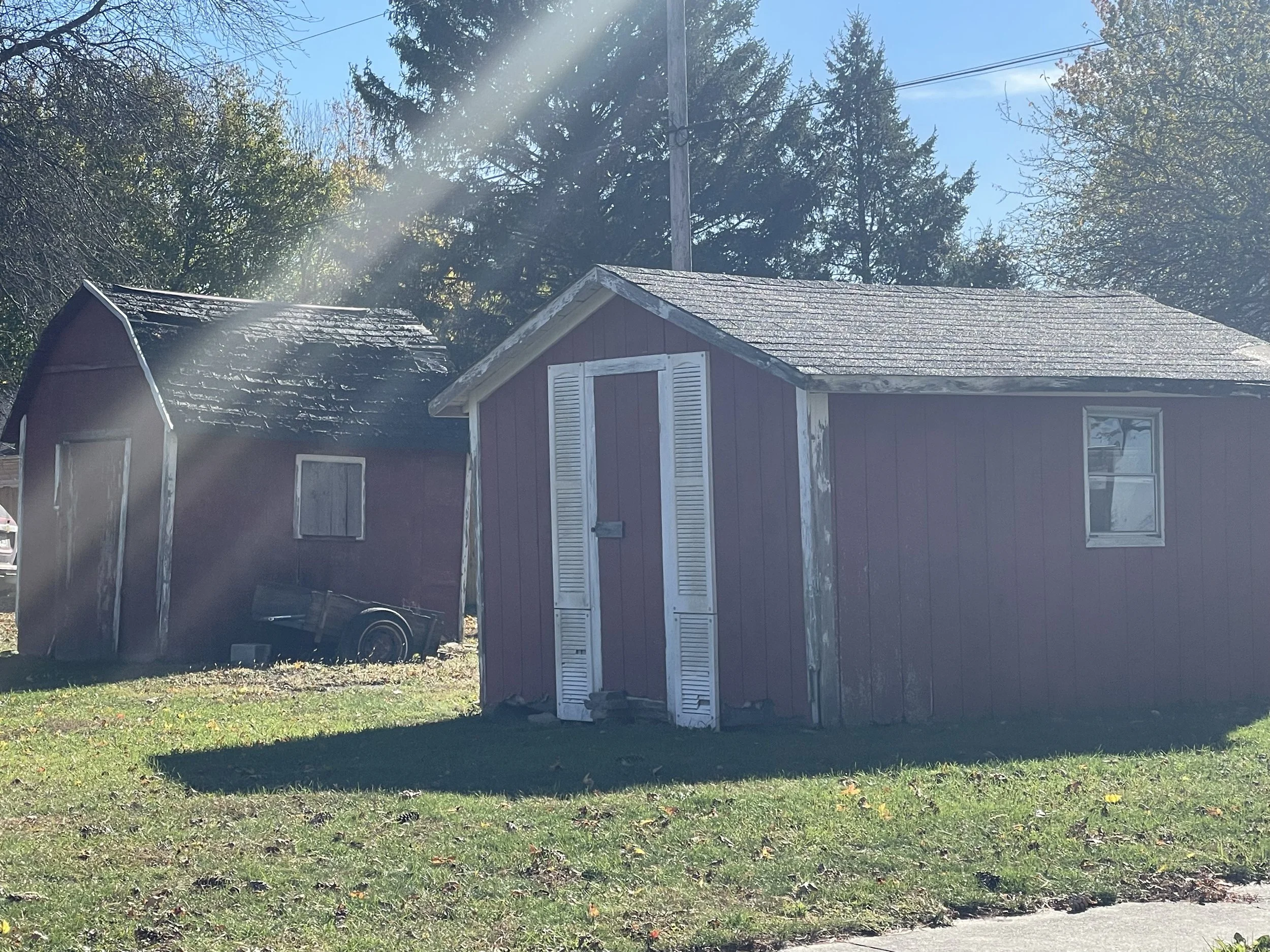
Grandpa’s chicken-coop studio. The shed in the background becomes important later.
My mom had noticed my interest in art years before that.
Some of the earliest evidence is apparently on the backs of church bulletins. I’d sit there and draw during church, and Mom noticed that I paid attention to details. Even before preschool, the people I drew had fingers on their hands and shoelaces on their shoes. By seventh and eighth grade, I was selected to take art for the entire school year.
Grandpa noticed too.
And somewhere around that time, a little tradition started.
At some point during nearly every holiday at Grandma and Grandpa’s house, Grandpa would take me out to the chicken coop because he had something new he wanted to show me. I didn’t think much about it then. It was just something we did.
Two Trees and a Path
In 1997, Grandpa gave me my first lesson in oil painting. We painted a landscape together.
A path and two trees.
He’d start a section and then hand me the brush or palette knife. I was supposed to watch what he had just done and try to mimic it and finish the section.
He’d paint. Then I’d paint. Then he’d take over again. Back and forth until we had a finished painting.
I still have it.
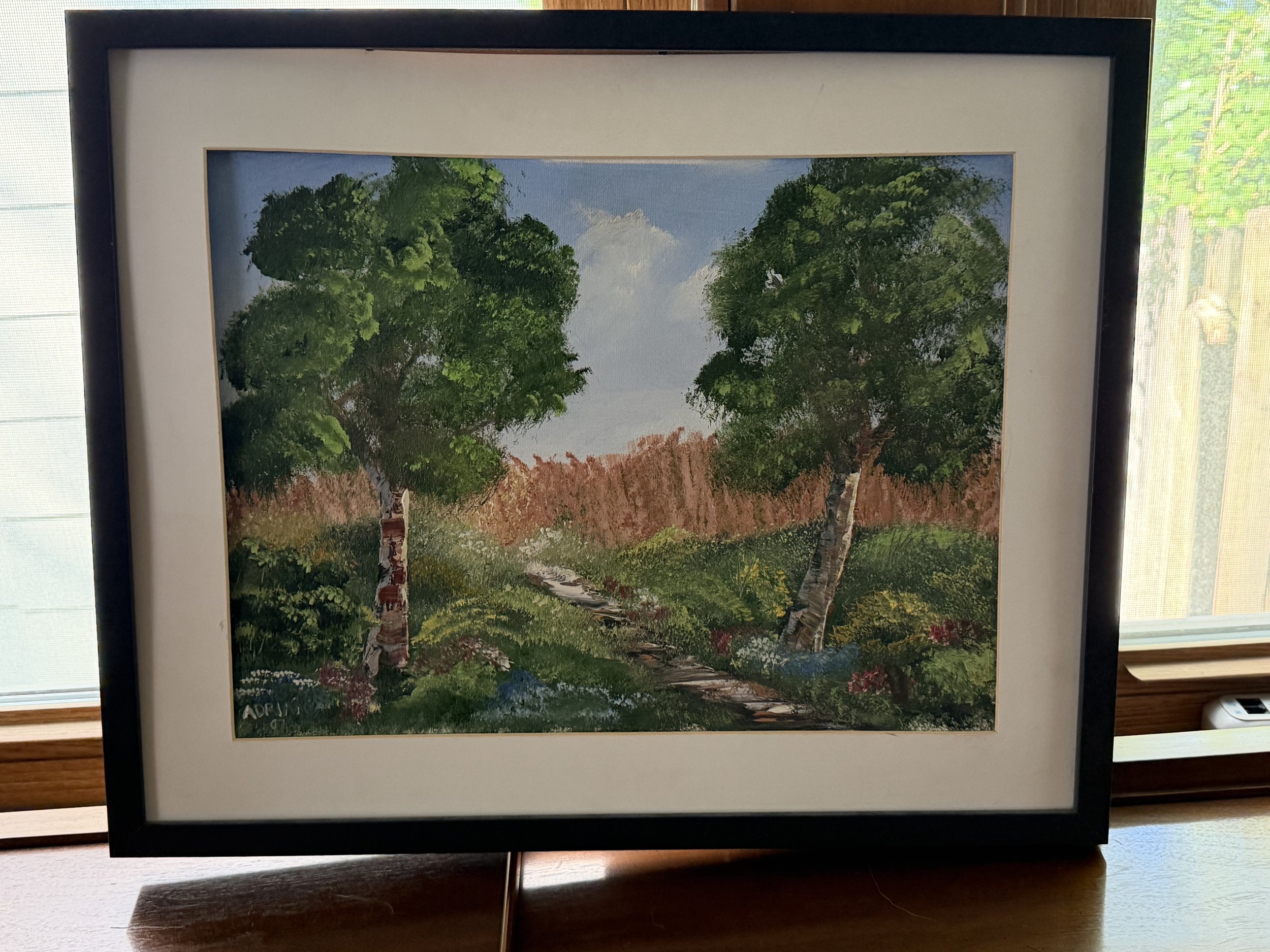
The painting Grandpa and I made together.
When I look at it now, I can’t necessarily tell you where Grandpa’s brushstrokes stop and mine begin. And I love that. It isn’t his painting. It isn’t mine. It’s ours. Though, he let me take sole credit.
Mom Was Never My Art Teacher
My mom never really taught me how to make art. That wasn’t her role. She supported me making it. And she still does.
Today, if I’m working on a painting and hit a roadblock, I’ll often call or send Mom a picture. Sometimes I’ve stared at something for so long that I can’t see it anymore. I just need another creative set of eyes. She’s one of those people for me. Now that she’s retired, she has a studio in her basement. She works in ink, watercolor, acrylic, gouache—whatever she feels like exploring.
She’s talented. She also doesn’t spend nearly enough time doing it. And she’s her own worst critic.
Apparently, that runs in the family.
The Paintings Grandpa Hid
After both Grandma and Grandpa passed within months of each other, our family was going through things on their property when we found something in another shed. Remember the shed behind the chicken coop? That one.
Inside was a pile of Grandpa’s canvases. Paintings none of us had ever seen.
There were multiple versions of some of the same paintings. Experiments. Attempts. Things that apparently hadn’t met whatever standard Grandpa had set for himself. His throwaways. He had put them away and never shown them to us, not even me.
Except none of us saw them as throwaways. We thought we’d found treasure. Everyone in the family got to choose three or four pieces they wanted. Grandpa had looked at those paintings and decided they weren’t worth displaying.
We couldn’t have cared less.
Grandpa painted them.
That was enough.
“Jack Finally Made It.”
There was one place my great-uncle Ralph always wanted Grandpa and his paintings to go. Key West. Ralph Wright was Grandma’s brother. He and his partner, Albert McCarthy, were humanitarians and philanthropists on the island for more than 50 years, loved orchids, collected art, and supported artists.
For years, Uncle Ralph wanted Grandpa to come down for a visit and bring some of his paintings. Grandpa never did. So after Grandpa died, I did it for him. I loaded some of Grandpa’s paintings into my car and drove them to Key West. One of those paintings showed three wooden sailboats sitting in a harbor. Somehow, that painting eventually ended up with one of Ralph’s friends.
I don’t know who has it today.
I don’t know exactly where in Florida it is.
I just know it’s hanging somewhere.
A painting by John “Jack” Current: a guy from Northwest Ohio who wasn’t a professional artist. A guy who started painting because his daughter wouldn’t paint the backdrop for his electric trains. Who learned by watching Bob Ross. Who painted in a carpeted chicken coop and probably appreciated being able to sneak a cigarette while he was out there.
And somehow, those three little sailboats made it all the way to Florida. When Ralph told my Aunt Linda about it, he said:
“Jack finally made it.”
Yep.
He did.
And Now I Have His Easel
Today, Grandpa’s easel is in my studio in Columbus, Ohio. His brushes are here. His palette knives are here. But the work I’m making looks absolutely nothing like his.
I take apart wedding bouquets and funeral arrangements. I attach flowers, petals, leaves, and stems to canvas. Then I paint. And paint. And paint. Until the flowers become part of something entirely new.
Abstract art. Which is particularly funny because neither Grandpa, nor Uncle Ralph were fans of abstract art. I’m sure they’d have notes.
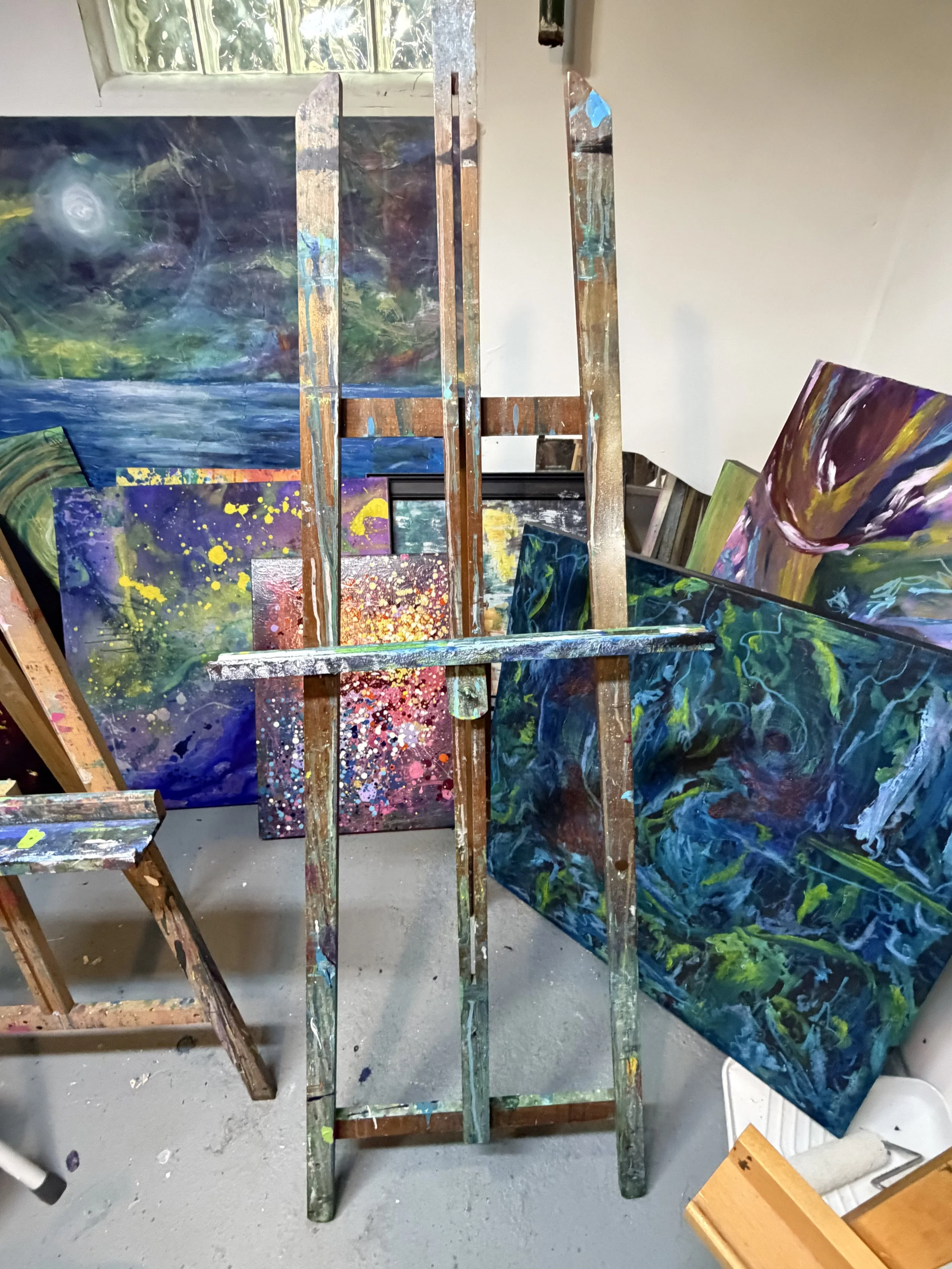
Every Heirbloom is created on my Grandpa’s easel.
But this is where the distinction between artist and preservationist matters to me. I didn’t become interested in art because I wanted to preserve flowers.
I came to flowers because I was already an artist.
When I began experimenting with flowers on canvas, I saw material. A petal could create texture. A leaf could create movement. A stem could create a line. The ridges and imperfections of dried flowers changed the surface underneath my paint in ways a flat canvas couldn’t. But there was one pretty significant difference between those flowers and everything else in my studio.
They already belonged to a story.
Someone carried them down an aisle.
Someone received them from a person they loved.
Someone pulled them from a funeral arrangement because they weren’t ready to throw them away.
Someone kept them tucked away for ten years because throwing them away never felt right.
That’s where the preservationist in me comes in. I know what I’m being trusted with. These aren’t just art supplies.
But once those flowers are on my easel, I have to be an artist. I have to be willing to take apart something that was beautiful exactly as it was. Sometimes I’m going to cover a flower completely. Sometimes I’m going to make a rose stop looking like a rose. Sometimes the painting is going to go somewhere neither I nor the person who gave me the flowers expected. Because I’m not trying to save a bouquet and put it on a wall.
I’m trying to make a piece of art that deserves to be on the wall in the first place.
The fact that the bouquet is inside it is what makes it theirs.
Artist First. Preservationist Second.
There isn’t some grand philosophy behind why I say it in that order. It’s just the order things happened.
First there was Mom.
Then Grandpa needed a backdrop for his electric trains.
Mom said no.
Then there was Bob Ross.
Then Grandpa started painting.
Then there was a chicken coop.
Then there was a seventh grader standing beside his grandpa, trying to repeat whatever he’d just done with a brush or palette knife.
Then there was a pile of paintings hidden in a shed that Grandpa didn’t think were good enough and the rest of us couldn’t wait to take home.
Then three little sailboats made their way to Florida.
And now there’s me, standing at Jack Current’s easel in my own studio.
Mom is still the person I call when a painting isn’t working.
The painting Grandpa and I made together is still mine.
Somewhere in Florida, Jack finally made it.
And I’m using his easel to make art neither one of us could have imagined back in that chicken coop.
So when I say I’m an artist first and a preservationist second, I’m not saying preservation matters less.
I’m saying I was an artist long before I ever thought about preserving a flower.
The flowers just gave me something new to paint.
