7 Things I Wish I Knew Before My First Wedding Show
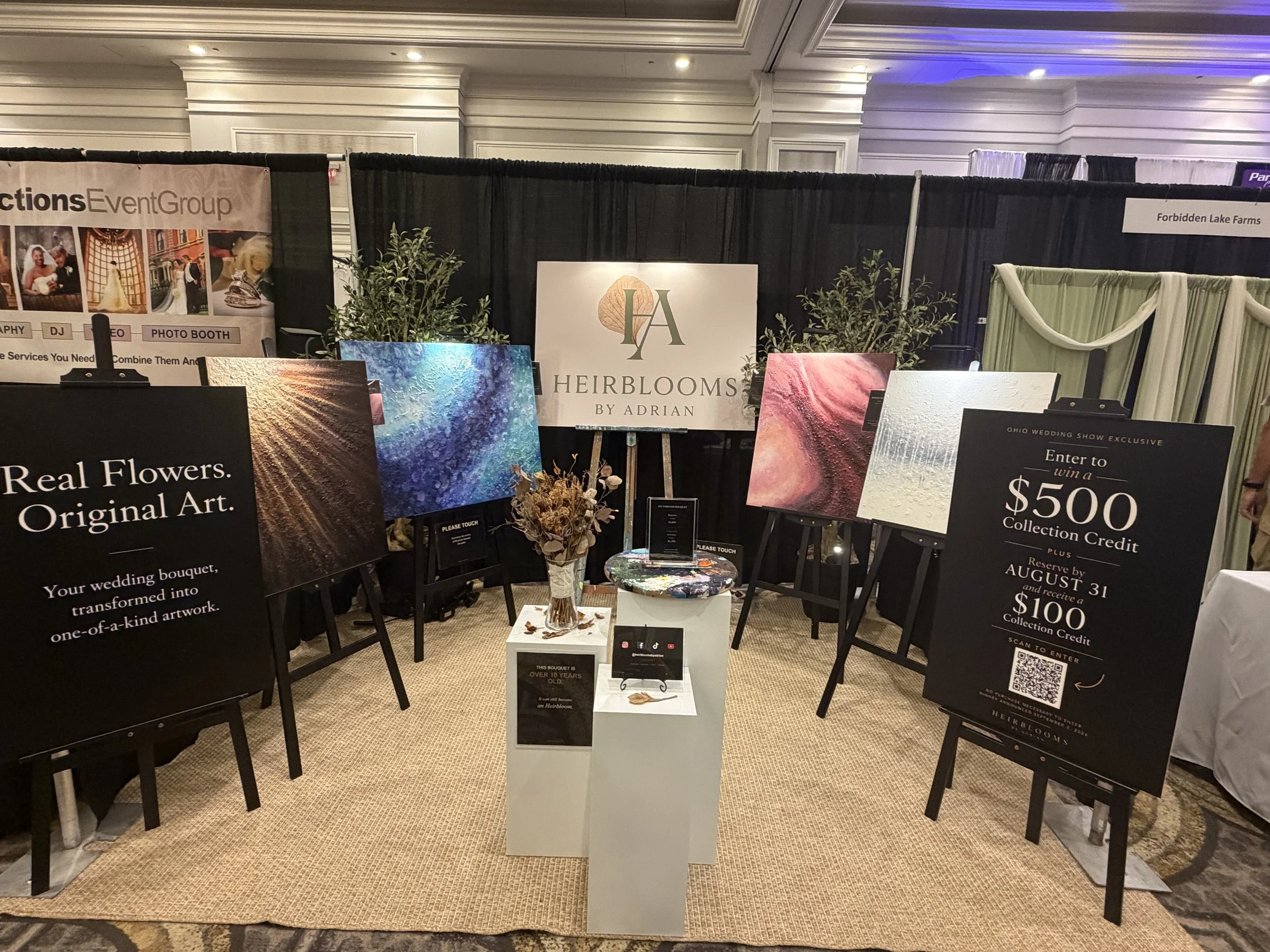
Heirblooms by Adrian making it’s Columbus wedding show debut.
A few weeks before my first wedding show, my studio basically turned into a staging area.
There were easels everywhere. Paintings leaning against walls. Signs being printed and reprinted. QR codes to test. Lights to figure out. An eight-foot rug rolled up in the corner. Two artificial olive trees that, for reasons I still can't entirely explain, became very important to me.
I spent a lot of time thinking about what the booth would look like.
What I didn't spend nearly enough time thinking about was what it would be like to experience the booth as someone who had absolutely no idea what Heirblooms was.
That turned out to matter a lot.
I create original artwork using flowers from wedding bouquets. The flowers are dried, incorporated into the canvas, and eventually become part of the texture beneath the paint. I've spent so much time developing the process that the connection between a wedding bouquet and the finished artwork feels completely obvious to me.
It wasn't obvious to everyone walking down the aisle of a wedding show.
Once people understood it, though, everything changed. I could actually watch the moment happen.
Wait. Those are the actual flowers?
Then they wanted to touch the painting. They wanted to know how I did it. They started imagining what their own bouquet might become.
That was probably the biggest lesson of the day, but it wasn't the only one.
Here are seven things I know now that I didn't know before my first wedding show.
1. People need to understand what you do almost immediately
I thought the paintings would explain Heirblooms.
They didn't.
They definitely got people's attention, but without context, they were beautiful abstract paintings sitting on easels. Someone walking through a crowded wedding show isn't going to stand there for two minutes studying your booth and trying to figure out your business model.
You have a few seconds.
Once I told someone that there were actual wedding flowers beneath the paint, the conversation became completely different. That's when the light bulb came on.
For my next show, I want that realization to happen before I even have to explain it.
2. I need to show the process, not just the result
This was probably my biggest practical mistake.
I brought the finished Heirblooms. I brought an old bouquet. I had signage explaining the concept. In my head, that was enough to connect the dots.
It wasn't.
At some point during the show, I put my phone on a little easel so people could see more of the process. It was basically an improvised solution to something I could tell wasn't working as well as I wanted it to.
Next time, there will be a screen.
I want someone walking past the booth to be able to see flowers being placed onto a canvas, see the painting process begin, and then look over and see the finished piece in front of them.
For something people already understand, that probably isn't necessary. But Heirblooms is a little strange to explain because there isn't a familiar category for it yet.
I've learned that's both an advantage and a challenge.
People are fascinated once they understand it. My job is to get them there faster.
3. QR codes are not nearly as magical as I wanted them to be
I had a QR code. I had an incentive to scan it. I had thought through where it would lead and what people would see when they got there.
And people did scan it.
But here's something that sounds incredibly obvious now: scanning a QR code and actually filling something out are two completely different things.
There are several little steps between noticing a QR code and becoming a lead, and at a wedding show there are approximately nine million things competing for someone's attention.
I still like QR codes. I'll use one again.
I just won't expect a little black-and-white square sitting on a sign to do all the work for me.
4. Everything needs to be bigger than you think
I had little instructions telling people they could interact with the artwork.
Too little.
They looked perfectly readable when I was setting everything up. Then the doors opened.
A wedding show is visually loud. People are moving. Vendors are talking. Brides are looking in six directions at once. Nobody is approaching your carefully designed five-by-seven sign like they're visiting an art museum.
The important information has to be visible from the aisle.
Next time, I'm going to be much more ruthless about signage. Fewer words. Bigger words. Clearer message.
If someone has to walk into the booth and lean forward to understand the most important thing I'm trying to tell them, the sign isn't doing its job.
5. A booth can technically fit everything and still be too small
I had a 10-by-10 booth, and I managed to fit everything into it.
Artwork. Easels. Table. Signs. Trees. Rug. Three human beings.
Mission accomplished.
Except not really.
The booth felt cramped, and I noticed that most people stayed along the aisle instead of actually walking into the space. That matters more than I expected it to.
Before the show, I thought about booth size in terms of how much I could display. Now I think about it in terms of how much room I'm giving someone to experience what I'm displaying.
I want people to walk in, get close to a painting, touch it, step back, look at another one and have a conversation without feeling like they've wandered behind the counter at a store.
I'm already thinking very differently about my next setup. If I have more room, I don't necessarily want to fill it with more stuff.
I want to fill it with more space.
6. The attendance number doesn't tell you nearly as much as you think it does
Before doing a wedding show, attendance is one of the numbers you naturally look at.
After doing one, I'm much more interested in who actually walks through the door.
My rough estimate is that there were around 200 brides at this show. Of those, only a percentage were ever going to be potential Heirblooms clients. That's just reality.
And that's changed the way I'm thinking about whether a show was successful.
I'm not sure the goal should be collecting as many names as humanly possible. I'd rather have a real conversation with someone who suddenly realizes she can turn her bouquet into artwork than have twenty people scan something because there's a giveaway attached to it.
Ultimately, I'll judge the show by what happens after it. But I'm already much less interested in big attendance numbers than I was before.
7. Your first wedding show is probably supposed to teach you things
I wanted the booth to be perfect.
Of course I did.
I'd spent weeks thinking about it, and by the time the show arrived I had stared at every individual piece of that setup for far too long.
But there were things I couldn't possibly know until actual people started walking past it.
I couldn't know where their eyes would go first. I couldn't know what they'd misunderstand. I couldn't know which questions I'd hear repeatedly. I couldn't know whether they'd walk into the booth or stand outside it. I couldn't know which part of the Heirblooms story would make someone stop and say, Ohhhh.
Now I know.
And that's worth something.
So, what will I change next time?
Quite a bit, actually.
I'll have a larger screen showing the process. The most important signage will be much easier to see. The relationship between the bouquet and the artwork will be immediately apparent. And I'm going to think much more carefully about how someone physically moves through the booth.
But I don't want to completely reinvent it.
The artwork worked. People wanted to touch it. Once they understood what they were seeing, they were genuinely surprised by it.
That's the part I keep coming back to.
Before my first wedding show, I thought my job was to create a beautiful booth that would make people stop.
Now I think my job is to create a booth that makes people understand.
Because the most interesting thing I watched all day wasn't someone stopping to look at a painting.
It was the moment they realized there were flowers underneath it.
And then watching their face change.
About Heirblooms by Adrian
Heirblooms by Adrian is a Columbus, Ohio floral preservation art studio transforming wedding bouquets and other meaningful flowers into original painted artwork.
Rather than recreating a bouquet exactly as it appeared, the flowers become part of something new—incorporated directly into the canvas and transformed through paint while their texture remains beneath the surface.
Where love and memories become art.
